
A 30% cash incentive on a broad eligible cost base, with room for qualifying foreign expenditure. Here is what the headline rate means for an international production.
Reviewed and updated: 27 September 2026
A REAL 30% — what matters is not just the rate, but what it applies to
The value of a film incentive is not determined by the percentage displayed in the largest type. What matters to producers is how much of the actual production spend qualifies for support. A higher advertised rate can still deliver a smaller saving if it applies to a narrower range of costs, the eligible base is capped, or the credit itself is taxable.
The UK's standard film Audio-Visual Expenditure Credit (AVEC), for example, offers a 34% credit, but its base is generally limited to 80% of total core production costs, and the credit itself is subject to corporation tax. The UK also has separate, more favourable rules for certain independent films and VFX expenditure. Nevertheless, the example illustrates the point: the advertised rate is not the same as the saving on the total budget.
One of Hungary's key advantages, by contrast, is its broad cost eligibility. The system starts with direct film production costs: except for statutory exclusions and limitations, these can form the incentive base. The 30% therefore applies to more than a handful of selected cost categories.
Qualifying crew, stage, equipment, location, set and post-production costs can all be included. The strength of Hungary's rebate is the combination of a cost base spanning the production and the 30% support applied to it.
Spending outside Hungary can qualify too
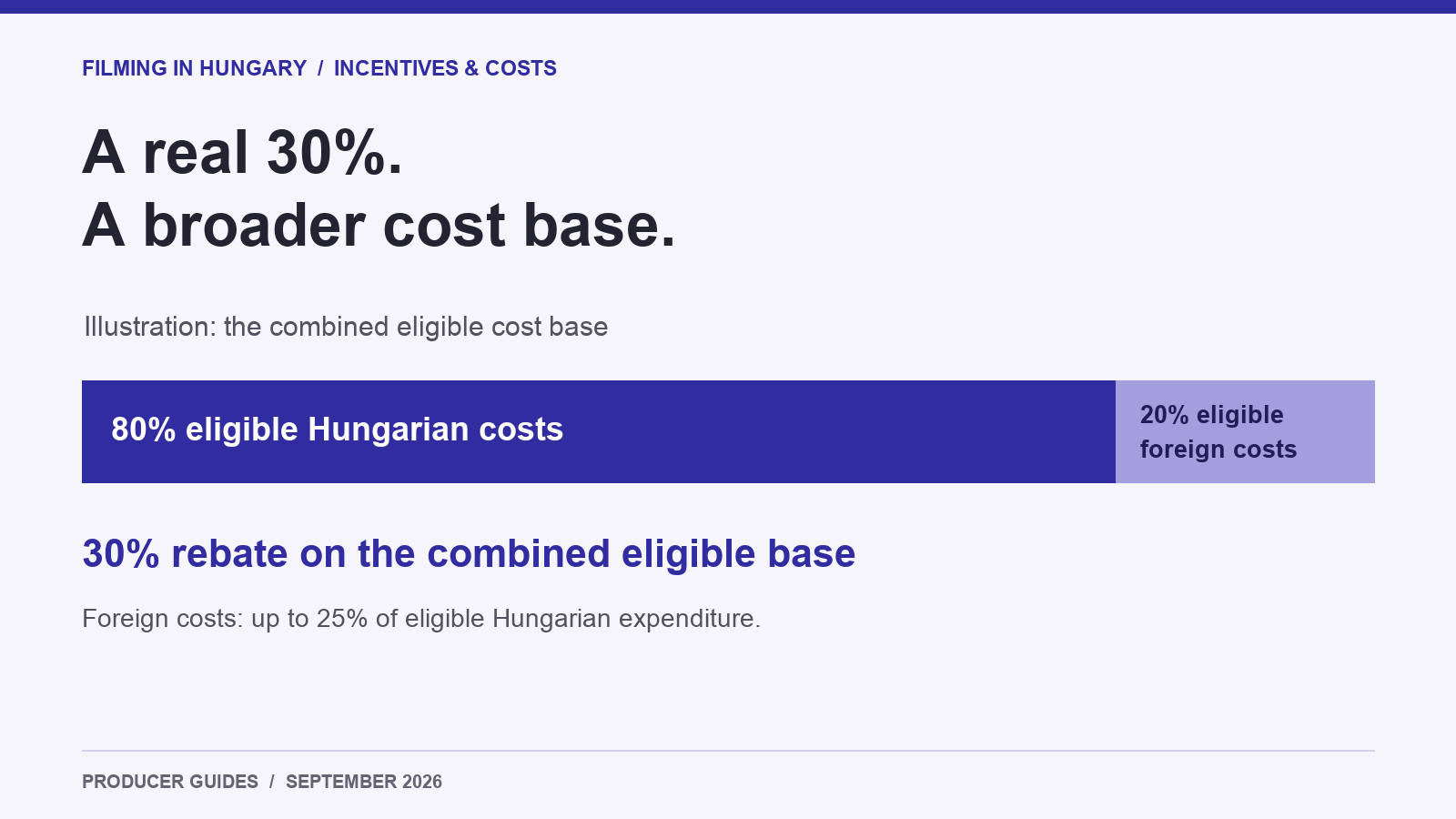
Another advantage of the Hungarian system is that it can accommodate qualifying foreign production costs. These may account for up to 20% of the combined eligible cost base — in other words, an amount equivalent to up to 25% of eligible Hungarian expenditure.
There is no lower rate for these costs: accepted foreign expenditure also attracts 30%. The expenditure must be included in the Hungarian production company's compliant accounts; simply adding any invoice held by the foreign producer is not enough.
How does 30% become 37.5%?
| Calculation | Hungarian costs only | Including foreign costs |
|---|---|---|
| Eligible Hungarian costs | €2,000,000 | €2,000,000 |
| Foreign costs included | €0 | €500,000 |
| Incentive base | €2,000,000 | €2,500,000 |
| Support at 30% | €600,000 | €750,000 |
| Support as a share of Hungarian spend | 30% | 37.5% |
In the second example, €750,000 is equivalent to 37.5% of Hungarian spend, while remaining 30% of the total eligible cost base.
The 37.5% is therefore not a support rate that can be applied to the film's entire international budget. It is the maximum relative to eligible Hungarian spend and requires a sufficient amount of actual, qualifying foreign expenditure. The euro figures are illustrative; the incentive is accounted for in Hungarian forints.
This is the essence of Hungary's offer: 30% support on a broad production cost base that can also include qualifying foreign expenditure. When choosing a location, producers should therefore compare more than national incentive percentages. They should compare the same production budget across territories: how much qualifies in each system, and how much support does it generate?
What does the producer receive?
Although the industry calls it a tax rebate, from the production's perspective it is a cash production incentive paid after eligible expenditure has been incurred and verified. It is neither a deduction carried forward against future profits nor a VAT refund.
The funding is linked to Hungary's corporate income tax system. Support is based on verified, accepted production costs; one of the main payment channels is the collection account managed by the National Film Institute.
A foreign producer can access the system through a production services or co-production agreement with a registered Hungarian production partner. That partner manages local expenditure, incentive documentation and cost reporting.
Which productions qualify?
Eligible formats may include:
- Feature films and short films;
- Television films and series;
- Feature films and series made for streaming platforms;
- Documentaries and science and educational films;
- Animation productions.
Commercials are not eligible under this scheme. News programmes, sports coverage, talk shows and game shows also fall outside the statutory definition of eligible film works. Shooting in Hungary does not in itself make a production eligible.
The project must also satisfy cultural requirements. This does not mean that it must be in Hungarian or tell a Hungarian story: the assessment also considers European cultural connections and the professional composition of the production. The system is therefore available to international, foreign-language productions too.
Which costs can attract support?
Eligible expenditure can cover a substantial part of production, rather than just the costs of shooting days.
| Cost category | Typical qualifying items |
|---|---|
| Crew | Fees and wages of production professionals |
| Studios and locations | Stage and location rental |
| Equipment | Camera, lighting and grip rental |
| Art department | Set construction, props and production materials |
| Logistics | Production-related transport, accommodation and catering |
| Post-production | Editing, colour grading, sound post and other qualifying post services |
The foreign cost allowance can include qualifying overseas shooting, equipment rental or post-production costs. This can be particularly useful when part of a production is carried out in Hungary and another part elsewhere.
Eligibility depends on more than where the work takes place. Who contracts and pays, how the cost is recorded, and whether it creates a Hungarian tax or contribution liability also matter. The law starts with paid expenditure supported by documentary evidence.
Some items have specific limits. For remuneration of foreign cast and crew taxable in Hungary, for example, the first HUF 3 million per person per film may be fully eligible, with generally 50% of the amount above that threshold qualifying. For a substantial cast fee, the contractual and tax structure can therefore materially affect the rebate.
How does the application work?
The process should begin during pre-production.
1. Eligibility and an initial calculation
The Hungarian partner reviews the production format, cultural qualification and budget. It separates Hungarian costs, foreign costs that can be included, and excluded expenditure. This forms the first rebate estimate.
2. Registration and documentation
The production is registered with the National Film Office. The application requires documents including a script, budget, production schedule, financing documentation and the appropriate production services or co-production agreement.
3. Production and cost reporting
The Hungarian production company collects and organises contracts, invoices, proof of payment and accounting records. Cost reporting is built alongside production, rather than reconstructed afterwards.
4. Cost verification and payment
The Film Office verifies the cost report and determines the accepted incentive base and support amount. Payment through the NFI collection account is based on this official decision.
Must the production finish before the money can arrive?
Not necessarily. With an appropriately structured reporting process, periodic cost reporting, for example quarterly, can be used during production. This is particularly important for longer series: the incentive process does not necessarily have to wait until the entire production is complete.
The rebate is nevertheless paid after eligible expenditure has been incurred and verified. Funding is needed for the period between paying production invoices and receiving the incentive.
Bank rebate pre-financing may be available, subject to individual credit assessment and agreement. The expected incentive can therefore help finance production, rather than only reduce its cost afterwards. Financing fees and interest must be included in the financing plan.
How much rebate could your production receive?
The key benefits of the Hungarian rebate are broadly eligible production expenditure, a 30% support rate and the ability to include foreign costs. Their combined effect should be reflected in the first location and budget comparison.
This requires a Hungarian production estimate showing clearly:
- How much Hungarian expenditure qualifies;
- Which foreign costs can be included;
- How much support is expected;
- How the incentive fits the production's financing schedule.
Planning a shoot in Hungary? Send the FilmingInHungary team a brief project description, your intended shooting period and available budget. We can assess the Hungarian production options and the potential rebate on that basis.
Sources and calculation notes
- HMRC — Audio-Visual Expenditure Credits
- National Film Institute — Hungarian Film Incentive
- Andersen — Tax Rebate for Film Productions
- Hungarian Motion Picture Act
- SYSPLEX — Rebate process and financing
General production-planning information, not a project-specific tax opinion. Eligibility, approved costs and financing terms must be confirmed for the production. Statutory accounting is in Hungarian forints.

