
One USD 5 million budget. Three cost structures. See how Hungarian expenditure, foreign costs and cast fees change the rebate.
Reviewed and updated: 27 September 2026
Illustrative USD 5 million budgets. Figures show calculated support before fees; the third example is rounded here and detailed below.
How much support can a USD 5 million film receive if it is produced in Hungary? With fully eligible Hungarian expenditure, USD 1.5 million. The same amount may also be available when 20% of the budget consists of qualifying foreign production costs. If foreign spending is higher, however, or a substantial share of the budget consists of cast fees with limited eligibility, the incentive base will be smaller.
The difference is not caused by a change in the support rate: that remains 30% in all three cases. What changes is how much of the film's budget the rate can be applied to.
The following examples start with the same USD 5 million production budget, using three different cost structures.
The basis of the calculation
In Hungary, qualifying foreign costs can be added to eligible Hungarian expenditure, up to 25% of the Hungarian cost base. The calculated support is 30% of the resulting amount.
Support = (eligible Hungarian costs + foreign costs included) × 30%.
The 25% foreign allowance represents 20% of the combined incentive base. This is why an 80% Hungarian–20% foreign split can allow the entire eligible budget to attract support.
The examples assume eligible productions and properly documented costs. No exclusions beyond those shown are included; figures represent support before fee deductions.
1. Entirely Hungarian expenditure: USD 1.5 million in support
The first film spends its entire production budget in Hungary. In this example, crew, stage, equipment, location, set and post-production costs are all fully eligible.
The calculation is straightforward: the USD 5 million budget is also the incentive base.
| Item | Amount |
|---|---|
| Total production budget | USD 5,000,000 |
| Eligible Hungarian costs | USD 5,000,000 |
| Foreign costs | USD 0 |
| Incentive base | USD 5,000,000 |
| Support at 30% | USD 1,500,000 |
Support equals 30% of the total production budget. The 37.5% figure does not apply here: qualifying foreign costs would also need to be included in the calculation.
2. 80% Hungarian, 20% foreign expenditure: still USD 1.5 million
The second film spends USD 4 million in Hungary and another USD 1 million on qualifying foreign production services. These might include overseas shooting or post-production costs properly accounted for by the Hungarian production company.
The foreign allowance is 25% of the Hungarian cost base: USD 4 million × 25% = USD 1 million. The film's foreign expenditure fits this limit exactly.
| Item | Amount |
|---|---|
| Total production budget | USD 5,000,000 |
| Eligible Hungarian costs | USD 4,000,000 |
| Foreign costs | USD 1,000,000 |
| Foreign costs included | USD 1,000,000 |
| Incentive base | USD 5,000,000 |
| Support at 30% | USD 1,500,000 |
The production receives the same support as in the first example, while spending one fifth of its budget abroad.
This is an important advantage of the Hungarian system. The USD 1.5 million incentive is 30% of the full budget, but 37.5% of the USD 4 million Hungarian spend. It is the same amount measured against a different base.
3. 70% Hungarian, 30% foreign expenditure, with substantial foreign cast fees
The third film has USD 3.5 million of Hungarian production expenditure and USD 1.5 million of foreign spending. However, the Hungarian portion includes USD 1 million in foreign cast fees that are not fully eligible.
The budget consists of:
- USD 2.5 million: fully eligible Hungarian production costs;
- USD 1 million: fees for two foreign actors, USD 500,000 each;
- USD 1.5 million: foreign production services.
The cast fees therefore represent 20% of the total budget and are included within the 70% Hungarian production portion, not added on top.
How much of the actors' fees qualifies?
In this example, the Hungarian production company pays and records the fees, and the actors, who are non-domestic individuals for the purposes of the rules, are subject to Hungarian personal income tax on that income.
Under this structure, 100% of the first HUF 3 million per person and 50% of the fee above that threshold can qualify as Hungarian film production costs. Simply halving the entire fee would therefore be incorrect.
For the dollar illustration, we use an assumed exchange rate of HUF 400 per USD. This is not a current exchange-rate quote; at this rate, the HUF 3 million threshold equals USD 7,500.
For one actor's USD 500,000 fee, the qualifying amount is:
7,500 + (492,500 × 50%) = USD 253,750
The two actors' combined USD 1 million fee therefore contributes USD 507,500 to the Hungarian cost base.
The adjusted cost base and support amount
Eligible Hungarian expenditure is therefore USD 3,007,500, not USD 3.5 million. The foreign cost allowance must now be calculated from this adjusted amount.
| Item | Amount |
|---|---|
| Total production budget | USD 5,000,000 |
| Other eligible Hungarian costs | USD 2,500,000 |
| Eligible portion of cast fees | USD 507,500 |
| Total eligible Hungarian costs | USD 3,007,500 |
| Actual foreign production costs | USD 1,500,000 |
| Foreign costs included: 3,007,500 × 25% | USD 751,875 |
| Incentive base | USD 3,759,375 |
| Support at 30% | USD 1,127,812.50 |
Support in this example is approximately USD 1.128 million, or 22.56% of the total budget.
Two factors reduce the amount: the partial eligibility of cast fees, and the fact that USD 1.5 million of foreign spending exceeds the permitted allowance.
This calculation applies to cast fees paid and recorded by the Hungarian production company. Fees paid directly by a foreign producer are subject to separate rules; they do not increase the base for the 25% foreign allowance in the same way.
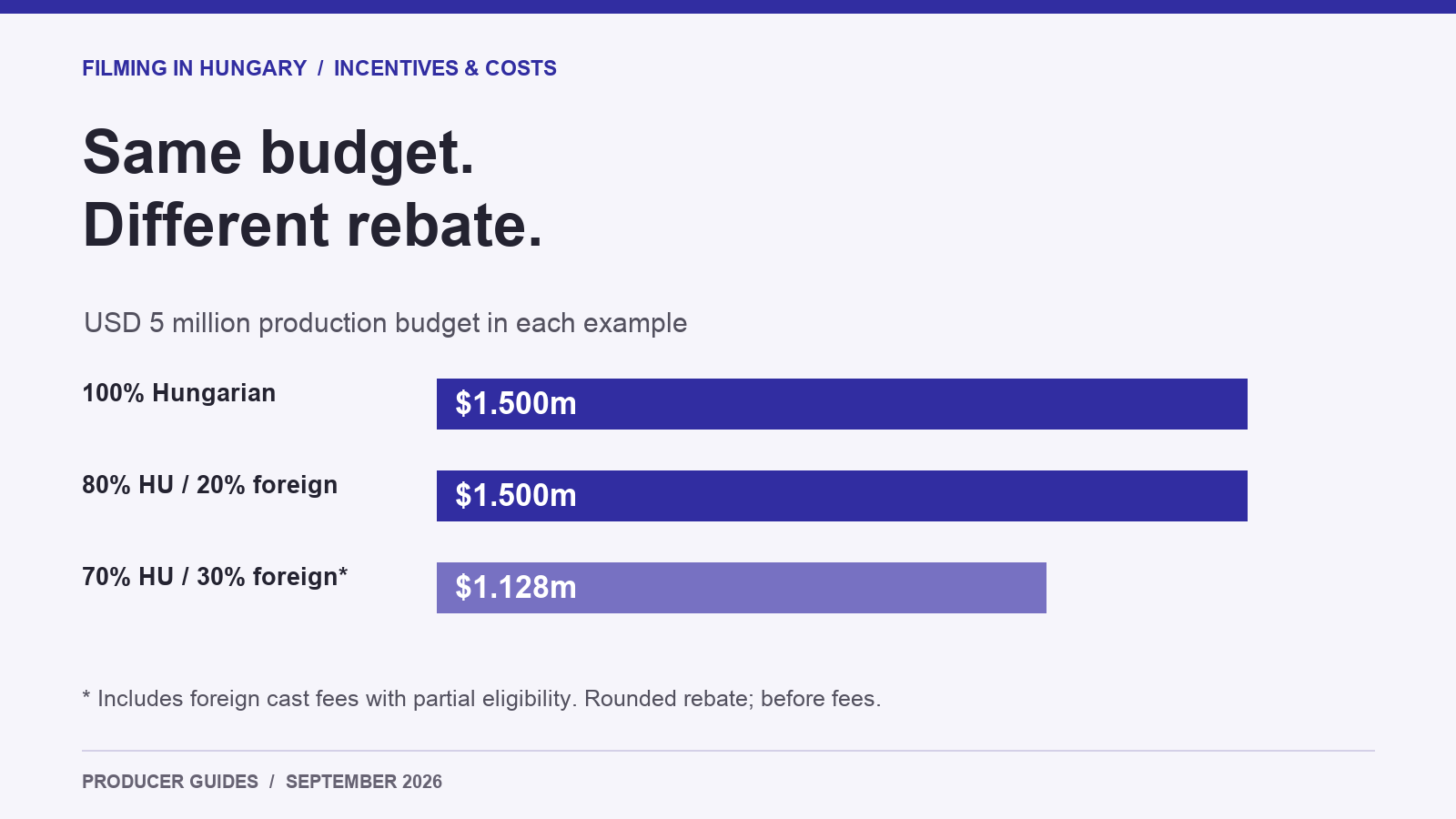
What do the three examples show?
With the same USD 5 million budget, the first two films generate USD 1.5 million in support, while the third generates approximately USD 1.128 million.
Under the Hungarian system, foreign spending does not necessarily reduce the incentive: the second example demonstrates this. To calculate the precise result, however, the eligibility of individual costs must be established first, before applying the foreign allowance and the 30% rate.
Would you like to see the numbers for your own film? Send the FilmingInHungary team your planned Hungarian and foreign expenditure, together with the principal cast fees. These provide the basis for a production-specific rebate estimate.
Sources and calculation notes
- Andersen — Tax Rebate for Film Productions
- Hungarian Motion Picture Act — section 31/F (1a), (2)–(2a)
General production-planning information, not a project-specific tax opinion. Eligibility, approved costs and financing terms must be confirmed for the production. Statutory accounting is in Hungarian forints.

